When a patient is in the Intensive Care Unit (ICU), every second matters. Their body is fragile, their breathing may depend on machines, and even small movements can affect their condition. In cities like Lucknow, many families face a difficult situation when their loved one needs to be shifted from one hospital to another for better treatment, advanced ICU facilities, or specialist care.
This is where a professional ICU ambulance service in Lucknow becomes extremely important. In this guide, we will explain in detail how ICU patients are transferred safely, what equipment is used, and how Shukla Ambulance ensures safe and smooth hospital-to-hospital transfers.
Â
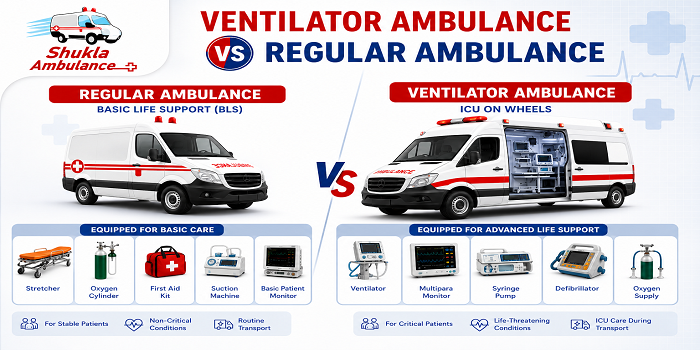
An ICU Ambulance is not just a mere ambulance. Rather, it is a mobile intensive care unit that is capable of keeping the critically ill patient alive and stable during the transport.
Â
A fully equipped ICU ambulance in Lucknow comprises of:
Â
• High-flow ventilator
• Multi-channel cardiac monitor
• Big-volume oxygen cylinders
• Vacuum machine
• Infusion and syringe pumps
• Cardioversion machine
• Emergency drugs
• Trauma and airway management equipment
• Corporal suspension stretcher
Â
At Shukla Ambulance, every single ICU ambulance is kept up to par with medical safety standards so that patients over the road will receive the same kind of care that they do in a hospital ICU.
Â
Numerous medical reasons exist for the transfer of ICU patients from one hospital to another. A few of the most common are:
Â
• Advanced ventilator support
• Need for a consultant like a cardiologist, neurologist, or trauma surgeon
• Surgery not performed in the existing hospital
• No dialysis, brain care, or cardiac ICU available
• Bed occupation in higher-level hospitals
• Prolonged ICU care
Â
In these circumstances, the use of a standard ambulance poses risks. Only a critical care ICU ambulance in Lucknow can guarantee the required medical assistance while the patient is being moved.
Â
Before shifting a patient, the treating doctor first checks
• Blood pressure
• Heart rate
• Oxygen level
• Level of consciousness
• Stability on ventilator or oxygen
Â
If the patient can be safely moved, the doctor prepares:
• Transfer summary
• Diagnosis
• Current treatment
• Oxygen or ventilator settings
• Emergency instructions
Â
This information is shared with the ICU ambulance team so they can prepare accordingly.
Â
Â
The patient’s family contacts Shukla Ambulance Lucknow and provides details such as:
• Patient’s medical condition
• Whether the patient is on ventilator
• Oxygen requirement
• Pickup hospital
• Destination hospital
Â
Based on this, we send the right ICU ambulance with trained medical staff.
Â
Before reaching the hospital, the ICU ambulance is checked for:
• Oxygen pressure
• Battery backup
• Ventilator function
• Monitor calibration
• Emergency medicines
Â
Everything is tested to ensure zero failure during transport.
Â
• The ICU team, upon arrival at the hospital, does the following:
• Observing patient vital signs
• Linking the patient to ambulance apparatus
• Making sure that oxygen, IV lines, and monitors are all in place
Â
There will be no movement of the patient until he or she has been declared medically stable for transport.
Â
Â
 This is probably the most delicate moment.
Our crew gently transfers the patient from the hospital ICU bed to the ambulance stretcher without inconveniencing:
Â
• Ventilator
• IV lines
• Oxygen tubes
• Monitoring wires
Â
There is continuous monitoring that guarantees no drop in oxygen or blood pressure.
Â
5. Monitoring During the Journey
• While the ambulance is moving:
• Ventilator keeps the patient breathing
• Cardiac monitor tracks heart rate and oxygen
• Trained nurse or paramedic stays beside the patient
• Emergency medicines are given if needed
Â
This makes ICU ambulance transport in Lucknow safe even for highly critical patients.
Â
Once the ambulance reaches the destination hospital:
• The patient is transferred directly to ICU
• Medical reports are handed over
• Doctor is informed about patient condition
Â
There is no break in life support, ensuring smooth continuation of treatment.
Â
Â
Many people think any ambulance is enough, but for ICU patients, this can be dangerous.
Â
• Normal ambulances lack:
• Ventilator
• Cardiac monitor
• Emergency medicines
• Trained ICU staff
Â
Using a non-ICU ambulance can lead to:
Â
• Oxygen drop
• Heart failure
• Sudden collapse
• Brain damage
Â
That is why choosing a professional ICU ambulance service in Lucknow like Shukla Ambulance is critical.
Â
Â
You should always call an ICU ambulance in Lucknow for patients who have:
• Ventilator support
• Severe breathing problems
• Heart attack
• Stroke
• Head injury
• Multiple trauma
• COVID or lung disease
• Organ failure
Â
These patients cannot survive without advanced medical support during travel.
Â
Shukla Ambulance is known for providing reliable and fast ICU ambulance services in Lucknow with:
• Fully equipped critical care ambulances
• Experienced ICU nurses and paramedics
• 24×7 emergency availability
• Fast response time
• Clean, safe, and modern vehicles
• Support for ventilator patients
Â
We understand that when someone is in ICU, every moment matters. Our job is to ensure the patient reaches the next hospital safely.
Â
Modern ICU ambulances use advanced technology such as:
• Digital patient monitors
• Portable ventilators
• Real-time oxygen tracking
• Battery-powered life support
Â
This allows continuous ICU-level care even on the road, which greatly increases patient survival chances.
Â
|
Problem |
How Shukla Ambulance Solves It |
|
Oxygen drop |
High-capacity oxygen cylinders |
|
Heart rhythm issues |
Cardiac monitors & defibrillator |
|
Equipment failure |
Backup power & devices |
|
Sudden deterioration |
Trained ICU staff onboard |
|
Road delays |
Fast and experienced drivers |
Â
Transferring an ICU patient is not just about moving a person — it is about moving a life that depends on machines, medicines, and medical expertise.
With a professional ICU ambulance service in Lucknow, patients remain stable, safe, and well-monitored throughout the journey.
If your loved one needs a hospital-to-hospital ICU transfer, trust
Shukla Ambulance – Lucknow for safe, fast, and medically secure transport.
Â