Written by the team at Shukla Ambulance Service. Reviewed by Hemendra Shukla, Founder. Last updated: October 2026.
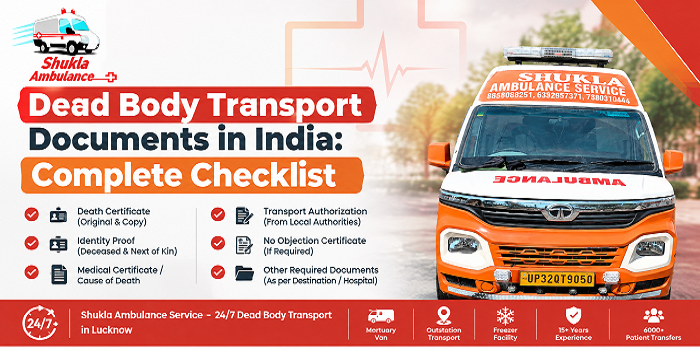
Most families need a death certificate or hospital death summary, ID proof of the deceased, ID proof of the person taking the body, and the hospital's release note. Trains, flights, and medico-legal cases usually require an NOC, and accident or unnatural deaths also need a post-mortem report and police clearance. Rules change by state and route, so confirm the final list with the hospital and the local police.
Here's the dead body transport documents checklist most families need. It covers the documents required to transport a dead body in India after a typical hospital death.
|
Document |
What is it for |
Who usually provides it |
|
Death certificate or hospital death summary |
Proof of death |
Hospital; municipal office for the official certificate |
|
ID proof of the deceased |
Confirms identity |
Family |
|
ID proof of the claimant |
Shows who is receiving the body |
Family |
|
Hospital release note |
Formal handover |
Hospital |
|
NOC or permission letter |
Needed for some routes and cases |
Police or local authority |
|
Post-mortem report |
Medico-legal cases only |
Hospital and police |
|
Embalming certificate |
Long journeys and flights |
Doctor or embalming facility |
Hold on to the originals and three photocopies. The checkpoints, railway personnel, and airlines usually maintain their own copies.
For local trips and most road journeys, the documents required to transport a dead body by road are the lightest: the death certificate or hospital summary, both ID proofs, and the release note. A police NOC is added when the case is medico-legal. Keep your dead body transport documents in one folder within reach, in case the vehicle is stopped at a checkpoint.
Trains have more stringent requirements. Death certificate, ID proofs, and NOC are some of the documentation that is needed when transporting the dead body via train, and the railways normally require that the body be embalmed and well-packed. You should go ahead and inquire at the parcel office of the station.
Airlines ask for the most. For the documents required to transport a dead body by flight, expect the death certificate, an embalming certificate, ID proofs, an NOC and a sealed coffin. Every airline runs its own cargo process, so call them early.
If the death follows an accident, assault, suicide or any unnatural cause, the case is medico-legal, and the body can't be released until the post-mortem is done. That makes the post-mortem report for dead body transport the key document. You'll also need a police NOC for dead body transportation and copies of the FIR or inquest papers where they apply. The police station handling the case will tell you what they need to sign off.
The hospital will provide you with the death certificate and the discharge certificate. Death registration and issuance of a certificate is done by the local authority, Nagar Nigam, in the case of Lucknow. According to the law, the death should be registered within 21 days of from the date of death. Police take care of the clearance process in case of medico-legal deaths.
Then, who issues the NOC for dead body transportation? Normally, police/local authority.
This process applies to short-distance as well as long-distance travel. For the former case, while dead body transportation documentation between the hospital and residence is simple, adhering to the same process will help keep you calm.
Get the death certificate/summary from the hospital.
Complete all the paperwork in the hospital and get the discharge note.
In case of a medico-legal case, complete the post-mortem report and collect all the documents from the police.
Collect all the identity proofs and photocopies of the same.
Arrange the vehicle after completing almost all the paperwork.
It occurs more frequently than expected. Should the death certificate not yet be obtained from the authorities, request a death summary form from the hospital, which would usually be the first document at hand. Should there be a mismatch between the name on the ID and that of the hospital records, have the records department rectify the same prior to departure. Should an NOC be pending for a medico-legal case, wait for the same. Moving the body without it will not be easy.
• Booking the vehicle before the paperwork is ready.
• Carrying only one copy of each paper.
• A claimant's ID that doesn't match the hospital record.
• Ignoring medico-legal requirements until the last minute.
• Assuming dead body transportation rules in India are the same in every state and for every route.
• Setting off with incomplete dead body transport documents and finding out at a checkpoint.
People often ask how to transport a dead body from one state to another. The documents needed to take a dead body to another city are the same as the checklist above. The difference is that you should also think about checkpoints along the route and the rules at the destination. Call the cremation ground or burial authority there in advance so nothing is left to chance when you arrive.
At Shukla Ambulance Service, we've handled patient and body transfers across Lucknow for more than 15 years, including regular trips to and from KGMU, SGPGIMS and Balrampur Hospital.
Experience note: in our work, distance is rarely what slows a family down. Paperwork is. A missing NOC in a medico-legal case or one photocopy left at home can hold things up for hours. Families who reach the mortuary with a complete folder of dead body transport documents usually have a much smoother day. If you're unsure about any paper, ask the hospital's records desk or the police station before you book.
Once you have your papers for transporting your dead body ready, choose the correct vehicle. You can use the mortuary van for short distances, and if you need to go long distances, use the deep freezer ambulance or freezer box for dead body transportation. Our dead body ambulance transport services take care of all your needs in that regard, while our dead body transport services in Lucknow will transport you from the city as well as other routes within Uttar Pradesh or the whole of India.
Having your dead body transport documents ready won't make the day easy, but it will make it clearer. Collect the death certificate, ID proofs, hospital release and any NOC or police papers, make copies, and check the rules for your route. If you need a respectful, well-equipped vehicle in Lucknow, call Shukla Ambulance Service on +91 63929 57371, any time of day or night.