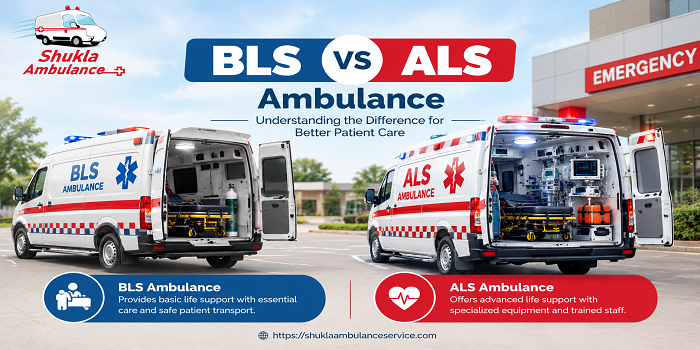
Nobody plans to book an ambulance. It usually happens at night, with a worried family and little time to think. Yet the ambulance that arrives decides what care your patient can receive on the road. This guide explains BLS vs ALS ambulance options in plain language so you can choose quickly.
Short answer: A BLS (Basic Life Support) ambulance suits stable patients who need basic care and safe transport. An ALS (Advanced Life Support) ambulance carries a cardiac monitor, defibrillator, airway equipment, and emergency medicines for critical patients. If a life may be at risk, choose ALS.
• BLS provides basic care and safe transport to stable patients.
• ALS lets the crew treat a patient during the journey.
• ICU ambulances are for the most critical cases.
• Cost depends on distance, equipment and staff.
• Not sure? Ask the treating doctor.
A BLS ambulance is a vehicle equipped to give basic medical support during transport, such as oxygen, vital sign checks, and first aid. That is the core BLS ambulance meaning: care that keeps a stable patient safe on the journey.
Equipment and staff: A stretcher, oxygen cylinder, suction unit, blood pressure monitor, pulse oximeter, splints and a first aid kit are standard. The crew is usually a trained driver and an attendant or emergency medical technician with first aid and CPR skills.
Typical use: BLS ambulance for patient transfer covers hospital discharge, stable transfers between hospitals for scans, and elderly or post-surgery patients who cannot travel in a regular car.
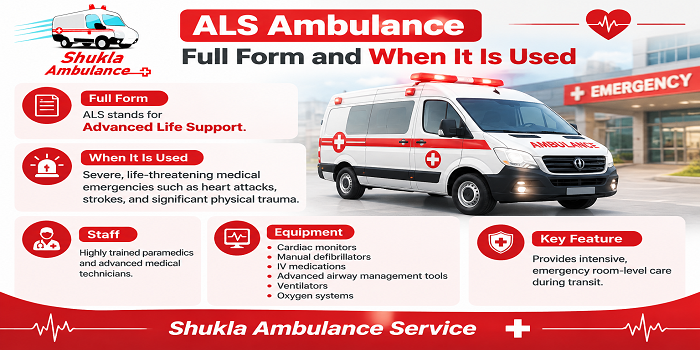
An ALS ambulance is equipped to treat a patient during transport, not just carry them. The ALS ambulance meaning is Advanced Life Support: everything in a BLS unit, plus tools to monitor the heart, support breathing, and give emergency medicines.
Equipment and staff: Typical items include a cardiac monitor with ECG, a defibrillator, a ventilator or advanced airway kit, IV lines and fluids, syringe pumps and emergency drugs.
This is the main gap in BLS and ALS ambulance equipment: BLS mainly moves the patient, while ALS treats the patient as the vehicle moves. Crews often include paramedics or nurses, and some providers add a doctor, so ask before you book.
Knowing when to use ALS ambulance support can save minutes. Choose it for suspected heart attack, stroke, severe breathing trouble, unconsciousness, seizures, heavy bleeding, serious accident injuries, or any patient who needs a ventilator or constant cardiac monitoring.
The difference between BLS and ALS ambulance is how much treatment the patient can receive on the way.
|
Factor |
BLS |
ALS |
|
Level of care |
Basic monitoring, first aid |
Advanced treatment in transit |
|
Typical staff |
Attendant or EMT |
Paramedic, nurse or doctor |
|
Key equipment |
Oxygen, stretcher, suction, BP monitor |
Cardiac monitor, defibrillator, ventilator, IV, and syringe pumps |
|
Best for |
Stable patients |
Critical or unstable patients |
|
Cost |
Lower |
Higher |
A simple rule for basic life support. vs advanced life support ambulance: BLS keeps a stable patient safe, and ALS treats a patient whose condition may worsen. Among the types of ambulance in India, these two are the most common, along with ICU, neonatal, air, and mortuary ambulances.
Ask three questions: Is the patient stable? Could they need treatment on the way? What did the doctor advise?
If the patient is awake, breathing comfortably, and only needs a safe ride, BLS is usually enough. With chest pain, breathing trouble, confusion, fainting, or a serious injury, choose ALS without delay. The BLS vs ALS ambulance decision is easier when the treating doctor or hospital guides it, so ask if you cannot tell. Shukla Ambulance Service, based in Lucknow, Uttar Pradesh, runs ambulance services 24/7.
ALS ambulance vs ICU ambulance is a difference of degree. An ICU ambulance works like a small intensive care room on wheels, with a ventilator, multi-parameter monitors, and infusion pumps, for the sickest patients and long transfers. ALS sits between BLS and ICU. For ventilator support or continuous intensive monitoring, see our ICU ambulance service page.
Rates differ between providers, so compare the details, not just the number. The main factors are distance, equipment and supplies used, and the level of staff on board. At Shukla Ambulance Service, charges are based on kilometres travelled and the medical instruments and kits used. Confirm the total before the journey starts.
• Stay calm and keep the patient still and comfortable.
• Loosen tight clothing and keep the airway clear.
• Keep medical papers, medicine lists, and ID ready.
• Give nothing to eat or drink if the patient is drowsy or in severe pain.
• Send someone to guide the crew to your exact location.
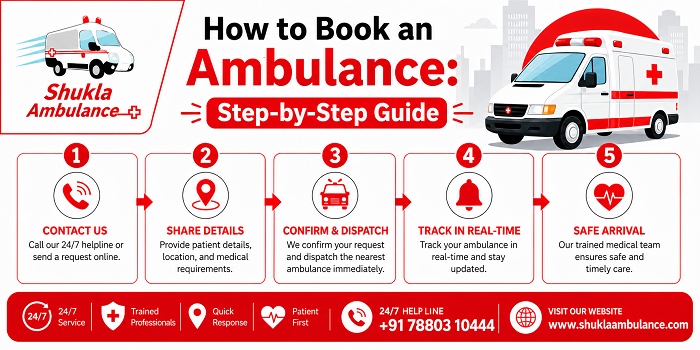
Knowing the BLS vs. ALS ambulance choice before an emergency helps you stay calm when it happens. When you call, have the patient's condition, current location, destination, and a contact number ready. Call Shukla Ambulance Service at [+91-6392957371, +917880310444] or use our booking page.