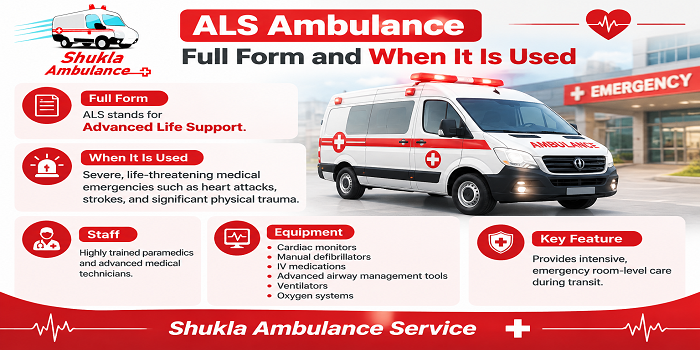
When someone you love needs urgent medical transport, terms like "ALS ambulance" can suddenly show up on hospital forms, insurance papers, or emergency responder vehicles — and most people have no idea what they mean. If you've searched for the ALS ambulance full form, you're not alone. This guide breaks it down in plain language: what it stands for, what's inside one, and exactly when doctors or families choose to use one instead of a regular ambulance.
The ALS ambulance full form is Advanced Life Support Ambulance. It's not just a fancy name — it describes a completely different level of care compared to a standard ambulance. While a regular ambulance mainly moves a patient from one place to another, an ALS ambulance is built to actively treat and stabilize a patient while that movement is happening.
In short: it's a moving emergency room, not just a moving vehicle.
An Advanced Life Support ambulance is staffed by trained paramedics or advanced emergency medical technicians who can perform interventions that go far beyond first aid. Think of it as a small, mobile version of a hospital's critical care unit. If a patient's condition could worsen suddenly — a failing heart rhythm, blocked airway, or dropping oxygen levels — the team inside an ALS ambulance is trained and equipped to act immediately, rather than waiting until arrival at the hospital.
This is exactly why understanding the ALS ambulance meaning matters — knowing the difference in advance can help a family make a faster, better decision during an actual emergency, when there's no time to research.
What separates an ALS ambulance from a basic one is the ALS ambulance equipment it carries. A typical setup includes:
• Ventilators – to support patients struggling to breathe on their own
• Cardiac monitors – to continuously track heart rhythm and detect danger early
• Defibrillators – to deliver a controlled shock in case of cardiac arrest
• Oxygen cylinders and masks – for patients with breathing difficulty
• Emergency medications – for pain management, cardiac stabilization, and resuscitation
• IV setup – for fluids or medication delivery en route
This equipment, combined with a trained paramedic, is what allows an ALS crew to treat a patient the moment something goes wrong — not after reaching the hospital doors.
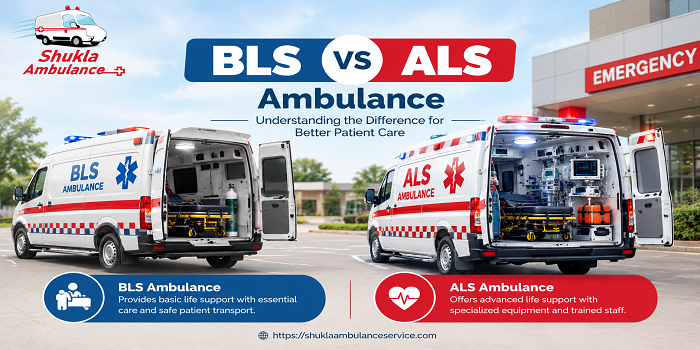
People often confuse full-service ambulance services with ALS ones, assuming they're interchangeable. They're not. BLS stands for Basic Life Support, and it covers a very different scope of care.
|
Feature |
BLS Ambulance |
ALS Ambulance |
|
Full Form |
Basic Life Support |
Advanced Life Support |
|
Staff |
Basic-trained EMT or attendant |
Paramedic or advanced technician |
|
Equipment |
First-aid kit, basic oxygen support |
Ventilator, defibrillator, cardiac monitor, medications |
|
Suitable For |
Stable patients needing simple transport |
Critical patients who may deteriorate during transport |
|
Typical Use |
Hospital discharge, routine transfers |
Cardiac emergencies, trauma, respiratory failure |
Understanding the difference between BLS and ALS ambulance services helps families avoid two common mistakes: paying for advanced care they don't need, or — far more dangerous — booking a basic ambulance for a patient who actually needs advanced monitoring.
This is the part most people actually want answered. An ALS ambulance is typically called in for:
• Cardiac emergencies — chest pain, irregular heartbeat, or suspected heart attack
• Respiratory distress — patients needing ventilator support or oxygen management during transit
• Unconscious or unstable patients — where vital signs could change rapidly
• Serious trauma or accident cases — where bleeding, shock, or internal injury is suspected
• Inter-hospital transfers — moving a critical patient from one facility to a better-equipped one, such as an ICU
• Post-surgical emergencies — where continuous monitoring is required during travel
If any of these situations sound familiar, that's your answer to "when is an ALS ambulance used" — it's whenever a patient's condition demands active medical care, not just a ride.
Another term that often causes confusion is MICU ambulance full form — Mobile Intensive Care Unit. While an ALS ambulance is equipped for advanced emergency intervention, an MICU ambulance goes a step further, often carrying ICU-trained staff and equipment closer to what you'd find in an actual hospital ICU. Simply put: BLS handles stable transport, ALS handles emergencies, and MICU handles the most critical, ICU-level cases requiring continuous specialist monitoring.
A simple way to decide:
• If the patient is stable and just needs to get somewhere, a BLS ambulance is enough.
• If there's a real risk of the patient's condition worsening en route — choose an ALS ambulance.
• If the patient is already in critical, ICU-level condition — an MICU ambulance is the safer choice.
When in doubt, it's always safer to call a service provider directly and describe the patient's condition — trained dispatchers can guide you toward the right vehicle rather than leaving that decision to guesswork during a stressful moment.
At Shukla Ambulance Service, we operate fully equipped ALS ambulance service vehicles staffed with trained paramedics and stocked with ventilators, defibrillators, cardiac monitors, and oxygen support. Our team is available 24/7 for emergencies, hospital transfers, and situations where every minute counts. If you're searching for a reliable advanced life support ambulance, our crews are trained to stabilize patients from the moment they arrive, not just transport them.